Why Your Core Needs More Than Just Crunches
The Limitations of Traditional Core Workouts
Many traditional core exercises, like crunches, primarily target the superficial “beach muscles,” such as the rectus abdominis (the “six-pack”). While these exercises have their place, they often fail to engage the deeper, more critical stabilizer muscles. This leads to a common pain point: individuals can have a toned-looking midsection but still suffer from chronic lower back pain, poor posture, and a higher risk of injury during dynamic movements because their foundational core stability is weak.
The Real-World Function of Your Core
Your core’s primary job isn’t just to look good; it’s to act as a sturdy, dynamic stabilizer for your entire body. It functions as a natural corset, bracing your spine and pelvis during everyday activities like lifting a heavy box, twisting to grab a seatbelt, or simply maintaining good posture while sitting at a desk. A strong, functional core is the bedrock of all powerful and safe movement, from athletic performance to simple daily tasks.
How Balance Boards Revolutionize Core Training
The Science of Instability
A balance board introduces a controlled element of instability. When you stand on one, your body is in a constant state of micro-correction. Your brain and nervous system have to work overtime, sending signals to a vast network of muscles—not just your abs, but your obliques, transverse abdominis, spinal erectors, glutes, and even the muscles in your feet and shoulders—to fire continuously to keep you upright. This creates a level of core engagement that is impossible to replicate on a stable surface.
Key Benefits of Integrating a Balance Board
- Superior Core Activation: Forces the engagement of the deep stabilizer muscles that floor exercises often miss.
- Improved Proprioception: Dramatically enhances your body’s awareness of its position in space, leading to better coordination and grace in all movements.
- Comprehensive Injury Prevention: Strengthens the kinetic chain from the ground up, protecting your ankles, knees, hips, and back.
- Enhanced Athletic Performance: Builds the type of dynamic stability and power transfer that is essential for sports like surfing, skiing, basketball, and running.
Balance Board vs. Other Core Modalities: A Quick Comparison
Balance Boards vs. Stability Balls
| Feature | Balance Board | Stability Ball |
|---|---|---|
| Primary Focus | Ankle, knee, and hip stability in a weight-bearing position. | Core stability in seated or supine positions, with spinal support. |
| Functionality | Highly dynamic; mimics real-world standing and moving challenges. | Excellent for isolation exercises and improving seated posture. |
| Portability & Cost | Generally more portable and often less expensive. | Larger and can be cumbersome to store and transport. |
Balance Boards vs. Pilates Reformers
| Feature | Balance Board | Pilates Reformer |
|---|---|---|
| Principle | Bodyweight control against a 360-degree unstable surface. | Precise, controlled movement against spring-based resistance on a track. |
| Accessibility | Low-cost, compact, and can be used anywhere. | High-cost, large equipment typically found in studios. |
| Skill Development | Focuses on reactive stability and full-body integration. | Focuses on muscular endurance, elongation, and perfect form. |
Getting Started: Your First Balance Board and Core Workout
Choosing the Right Balance Board
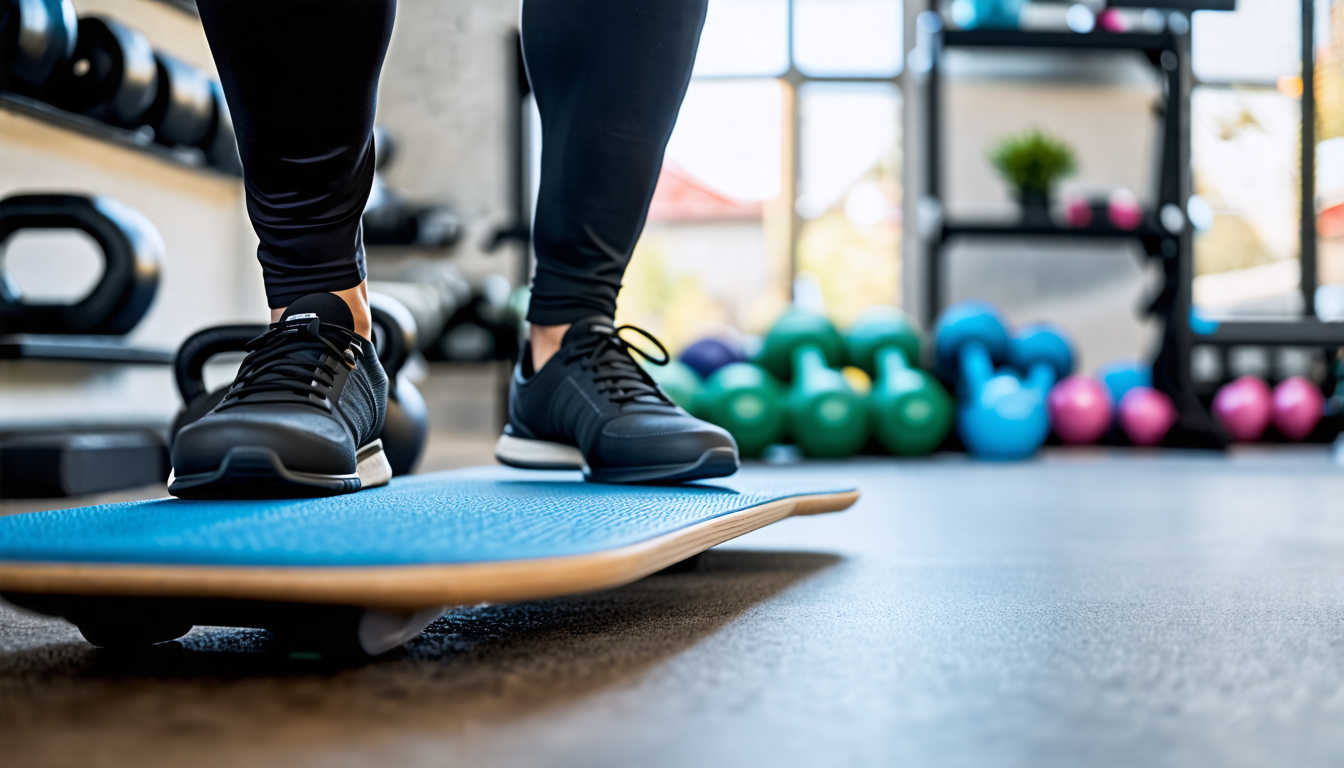
For beginners focused on core training, a wobble board (a round board on a single, domed pivot) is often the most versatile and user-friendly option. It provides a good range of motion for tilting in all directions without being overly intimidating.
Foundational Exercises for Beginners
- Static Hold: Simply stand on the board and find your center of balance. Hold for 30-60 seconds. This is your foundational skill.
- Mini Squats: While balanced, perform shallow, controlled squats. This teaches you to stabilize your core and lower body simultaneously.
- Clock Tilts: Deliberately tilt the board to tap the edge at 12, 3, 6, and 9 o’clock positions. This builds control through a full range of motion.
Advanced Progressions to Level Up
- Board Planks: Place your forearms on the board and hold a plank position. For an extreme challenge, place your feet on the board instead.
- Overhead Presses: Hold a light dumbbell or kettlebell in each hand and perform an overhead press while maintaining your balance.
- Wood Chops: Hold a single weight with both hands and perform a diagonal chopping motion from high to low across your body.
Common Mistakes and How to Avoid Them
- Pain Point: Looking down at your feet. Solution: Fix your gaze on a stationary point on the wall in front of you. This helps with overall balance and spinal alignment.
- Pain Point: Locking your knees. Solution: Maintain a soft, slight bend in your knees at all times. This engages the leg muscles and protects the knee joints.
- Pain Point: Starting with exercises that are too advanced. Solution: Master the basic static hold before adding movement. Always have a wall or chair nearby for support when trying something new.
Beyond the Core: The Surprising Benefits of Balance Training
Cognitive Enhancement and “Neuro-Motor” Training
This is a unique benefit many overlook. Balance training is as much a cognitive workout as a physical one. Your brain is forced to integrate sensory input from your eyes, inner ears (vestibular system), and proprioceptors in your joints to execute coordinated muscle commands. This “neuro-motor” challenge has been shown to improve cognitive functions like processing speed, memory, and reaction time. It essentially builds new neural pathways, making it a powerful tool for brain health and longevity, helping to stave off age-related decline.
Stress Relief and Mindfulness
The intense, singular focus required to stay balanced on a board forces you into the present moment. There’s no room to ruminate on your to-do list or daily stresses when your full attention is demanded by the task at hand. This creates a state of “flow” or moving meditation, which can significantly lower cortisol levels and provide a genuine sense of mental calm and accomplishment after a session.
Frequently Asked Questions (FAQs) About Balance Boards and Core Training
Are balance boards safe for people with back pain?
They can be exceptionally beneficial, as they strengthen the deep stabilizers that support the spine. However, it is absolutely crucial to start with the most basic exercises and, if you have a known back condition, to get clearance from a physical therapist or doctor first. The cause of back pain is highly individual.
How often should I use a balance board for core training?
For most people, 2-3 sessions per week is the sweet spot. This allows for adequate recovery, which is when your muscles and nervous system actually adapt and grow stronger. Quality over quantity is key.
Can I use a balance board if I have poor balance?
Yes! In fact, that’s the best reason to start. Everyone begins with poor balance on an unstable surface. Use a wall, counter, or sturdy chair for support. With consistent practice, you will be amazed at how quickly your balance and confidence improve.
Will a balance board help me get a six-pack?
A balance board will build the strong, dense, and functional core muscles that lie beneath the superficial “six-pack” muscles. While it will contribute to a more toned and solid midsection, visible abs are primarily revealed through a reduction in overall body fat, which is achieved mainly through a consistent caloric deficit and proper nutrition.