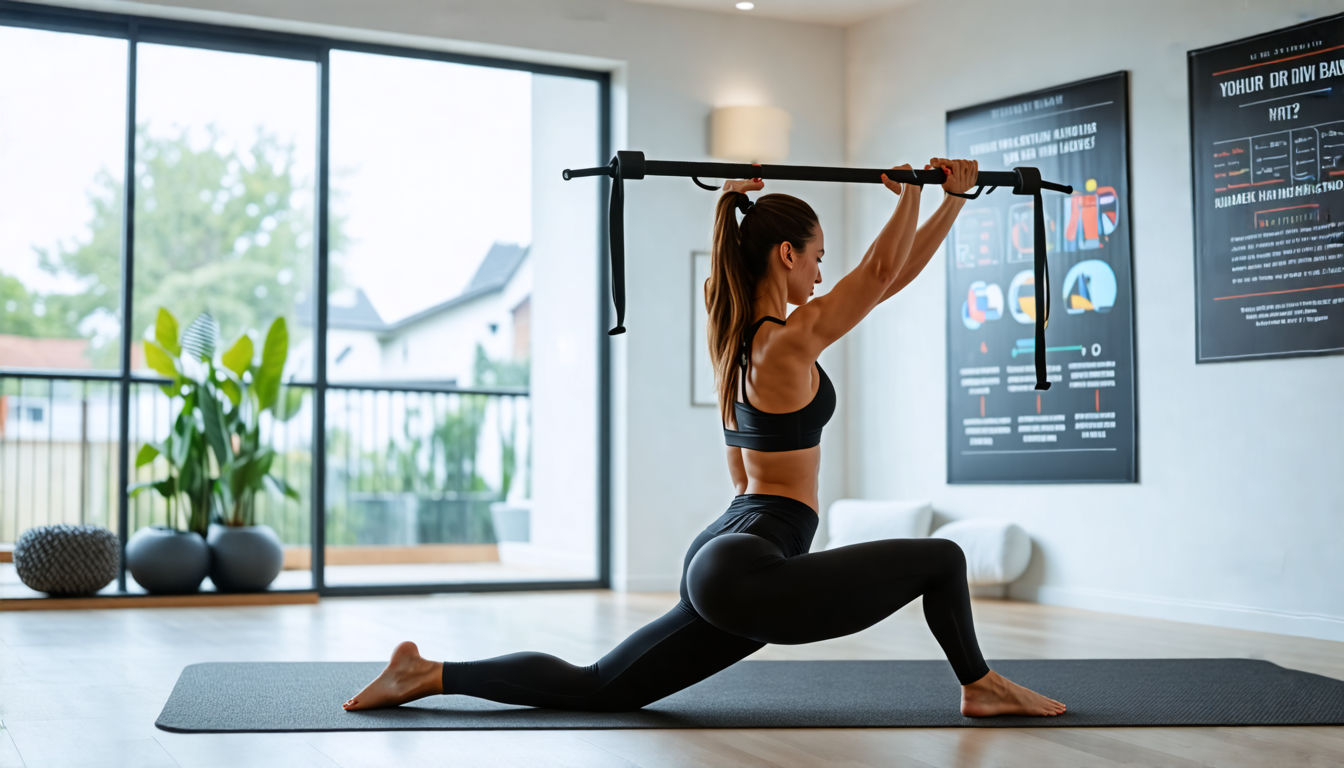
The Vision of a Complete Home Gym
Imagine a training session of pure, unbroken flow: you finish a set of powerful pull-ups, feeling your back muscles ignite, and without a moment’s pause, you transition into a set of deep, controlled dips that fire up your chest and arms. This seamless, professional-grade efficiency isn’t reserved for commercial gyms. It’s the hallmark of a well-understood home setup, built on two fundamental pillars: the pull-up bar and the dip bar.
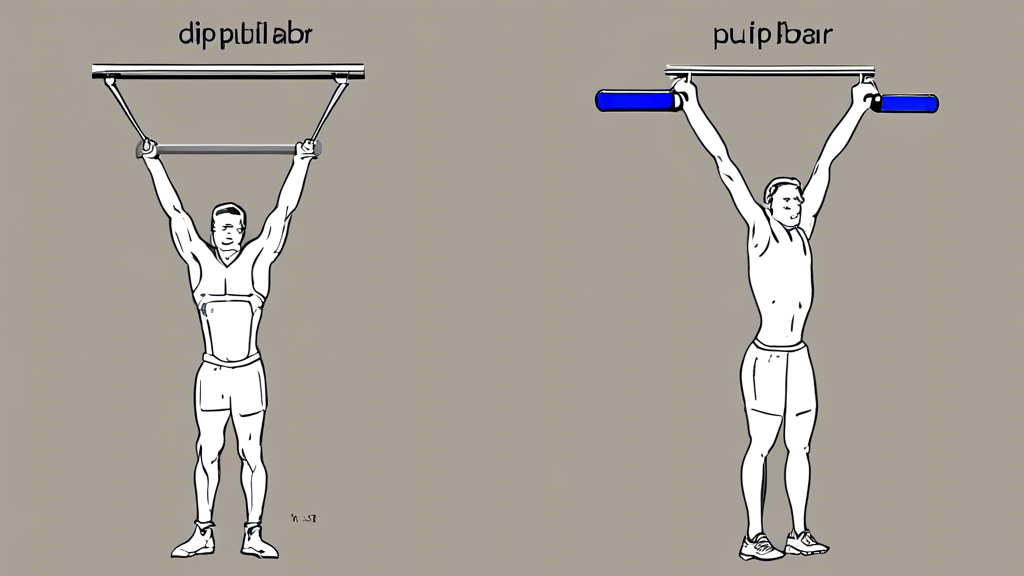
While they may seem like simple bars of steel, each is a masterfully engineered tool for a distinct physiological purpose. Understanding how a pull-up bar differs from a dip bar is the critical first step. It’s the knowledge that transforms random exercises into a strategic system, allowing you to construct a balanced, powerful upper body with the precision of an architect.
Foundational Choices: Purpose-Built Hardware
In strength training, your tools dictate your potential. Selecting equipment based on convenience alone leads to plateaus and imbalances. You must choose the right apparatus for the specific job, as each is designed to facilitate—and optimize—a unique family of movements.
Primary Function & Movement Patterns
The core distinction is absolute:
- The Pull-Up Bar is engineered for vertical pulling. Its sole purpose is to serve as a fixed, overhead anchor point from which you move your body upward. Think of it as your launchpad for developing a wide, powerful back.
- The Dip Bar is engineered for vertical pushing and bodyweight support. Its purpose is to provide two stable, parallel platforms between which you can lower and raise your body. Think of it as your scaffold for building pressing strength and torso stability.
Structural Design & Physical Form
This functional divide manifests in unmistakable physical forms:
- Pull-Up Bar: Characterized by a single, horizontal bar. It can be mounted in a doorway, on a wall, or as part of a larger power rack or freestanding station. Its design is often minimalist, focused purely on providing a secure grip overhead.
- Dip Bar: Defined by two parallel bars or handles. Common configurations include U-shaped stations, rectangular frames with parallel bars, or even standalone handles. The design prioritizes a stable base and a width that allows full clearance for your torso.
Material & Component Comparison
| Component Category | Pull-Up Bar Options | Dip Bar Options |
|---|---|---|
| Primary Structure | Fixed single bar, multi-grip bars (with varying hand positions). | Parallel bars, angled “V” bars, assisted dip stations with counterweight. |
| Key Characteristics | Minimalist anchor point. The focus is on secure overhead mounting and grip variety to target back muscles from different angles. | Dual-support system. The focus is on stable, weight-bearing platforms wide enough for torso clearance and to prevent lateral sway. |
| Mounting/Stability Needs | Requires extremely secure attachment (e.g., into wall studs or a robust frame) to withstand dynamic, full-body pulling forces and potential kipping motions. | Requires a wide, stable base or secure floor mounting to prevent tipping or shifting during the asymmetrical loading of a dip. |
The Core System: Biomechanics and Muscle Targeting
Beyond their shape, these bars create entirely different physiological environments. Mastering them means understanding the biomechanical systems they control—the specific levers, angles, and muscle groups they are designed to engage.
The Pull-Up Bar System (The Pulling Environment)
- Target Muscles: Latissimus dorsi (the primary “wing” muscles of the back), biceps, rear deltoids, and the core (when performing knee or leg raises).
- Movement Vector: Your body moves upward toward the fixed bar. You are closing the space between your chest and the anchor point.
- Primary Control Variable – Grip: Your hand position dictates emphasis. A pronated (overhand) grip targets the lats more; a supinated (underhand) chin-up recruits more biceps; a neutral grip is often shoulder-friendly.
The Dip Bar System (The Pushing/Support Environment)
- Target Muscles: Triceps (primary in a more upright dip), pectorals (chest), anterior deltoids (front shoulders), and core (for stabilizing the torso in a static hold).
- Movement Vector: Your body is lowered and pushed up between two fixed bars. You are moving within the space defined by the parallel supports.
- Primary Control Variable – Torso Lean: A more upright posture emphasizes the triceps. Leaning the torso forward shifts the load significantly onto the pectorals, transforming the movement.
Advanced Practices: Optimization and Programming
With the foundation set, you progress from merely using the tools to mastering the practice. This is where knowledge translates into superior results.
Exercise Progression & Scaling
Each bar offers a clear pathway from beginner to advanced:
| Tool | Beginner Progression | Advanced Progression | Scaling Methods |
|---|---|---|---|
| Pull-Up Bar | Band-assisted pull-ups, inverted rows | Strict weighted pull-ups, muscle-ups, typewriter pull-ups | Use resistance bands for assistance, perform negative (eccentric) reps, use a leg for assistance on rows. |
| Dip Bar | Bench dips, assisted dips with bands | Weighted dips, ring dips, L-sit dips | Use a band for lift-off assistance, limit range of motion, perform negative reps with controlled descent. |
Unlocking Compound Routines
The true power is revealed when you integrate both tools into a synergistic system.
- Strategic Pairing: Supersetting pull-ups (a pull) with dips (a push) is a time-efficient, brutal, and highly effective method for stimulating total upper body growth. They are complementary movements that don’t interfere with each other’s performance.
- The Unifying Exercise – The Leg Raise: Both bars serve as an exceptional platform for core development. From the pull-up bar, you perform hanging leg raises. From the dip bar, you perform support leg raises or L-sits. The former challenges your grip and back stability; the latter challenges your shoulder stability and compression strength.
Safety and Problem Prevention
Mastery is not just about performance; it’s about sustainability. A proactive approach to safety ensures your progress is never derailed.
Prevention – Form and Setup
- Pull-Up Bar: The greatest risks are shoulder impingement from shrugging at the start of the pull, and catastrophic mount failure. Solution: Initiate every rep with a deliberate retraction and depression of the shoulder blades (“pack your shoulders”). Ensure the bar is mounted securely into wall studs or a manufacturer-rated support.
- Dip Bar: The primary risks are shoulder strain from descending too deep with poor mobility, and instability leading to a fall. Solution: Control your descent; only go as low as your shoulder flexibility comfortably allows (typically upper arm parallel to the floor). For freestanding bars, ensure they are on a non-slip surface and that you maintain vertical alignment during the movement.
Intervention – Recognizing Limits
Learn to distinguish between productive muscle fatigue and problematic joint pain. Sharp pain in the shoulder, elbow, or wrist is a signal to stop immediately. Persistent soreness in these joints often indicates the need to regress the exercise, reduce volume, or focus on mobility work before advancing again.
A Sample Weekly Integration Blueprint
This practical framework shows how to wield both tools strategically across a training week.
| Training Day | Primary Tool | Focus & Sample Exercises |
|---|---|---|
| Day 1: Vertical Pull Dominant | Pull-Up Bar | Vertical Pulling & Core: 4 sets of Pull-Ups (varying grips), 3 sets of Hanging Knee Raises, 3 sets of Inverted Rows. |
| Day 2: Vertical Push Dominant | Dip Bar | Vertical Pushing & Stability: 4 sets of Chest Dips (forward lean), 3 sets of L-Sit Holds (scaled as needed), 3 sets of Triceps-Focused Dips (upright torso). |
| Day 3: Integration & Synergy | Both Bars | Upper Body Synergy: Perform a circuit of 3 rounds: 8 Pull-Ups, 10 Dips, 12 Bodyweight Rows (using the pull-up bar low). Finish with 3 sets of Support Leg Raises on the dip bars. |
The Transformation to Mastery
This journey begins and ends with a simple, powerful truth: understanding how a pull-up bar differs from a dip bar is what allows you to command both halves of the upper body strength equation. It moves you from random exertion to purposeful training.
You start by selecting the right hardware for the job—the overhead anchor for pulling, the parallel supports for pushing. You then learn to manipulate the systems they control: your grip and your torso lean. Finally, you synthesize this knowledge into intelligent programming, weaving the tools together to create a routine greater than the sum of its parts.
With this understanding, your home space is no longer just a room with some equipment. It becomes a precision strength lab. The pull-up bar and dip bar cease to be mere objects; they become extensions of your will, the fundamental instruments for forging a resilient, balanced, and powerful physique. The unparalleled satisfaction that comes from this self-built mastery is the ultimate reward, a testament to the power of knowing not just how to work, but what to work with.