The Vision of Effortless Strength
Imagine the smooth, powerful ascent of a perfect pull-up. Your body moves as a single, coordinated unit—lats flaring, core braced, shoulders packed—as you effortlessly pull your chin over the bar. This isn’t just an exercise; it’s a display of pure, functional strength. The journey from struggling with a single rep to performing sets with controlled power begins with one essential tool: your home fitness bar. Mastering its strategic use is the foundational key to unlocking superior pull-up strength, impeccable technique, and unshakable consistency. This guide is your blueprint for that mastery.
Foundational Choices: Your Pull-Up Hardware
Your fitness bar is more than equipment; it’s your training partner and the bedrock of your progress. The right choice enables safe, effective, and limitless training.
Part A: Selection and Sizing
Choose a bar that aligns with your space, commitment, and goals. Doorway bars offer supreme convenience for beginners focusing on strict pull-ups. Wall-mounted and ceiling-mounted bars provide a permanent, robust solution for dedicated training areas. Free-standing power cages or squat stands with pull-up bars are the ultimate choice, offering unmatched stability for advanced movements like kipping or muscle-ups and the ability to add significant weight.
Part B: Location and Secure Setup
Placement is critical. Ensure you have full, unimpeded range of motion—your feet should clear the floor in a dead hang, and your head should not hit the ceiling at the top. For doorway bars, always install on a sturdy door frame and use the provided supports to distribute force. For permanent installations, anchor into wall studs or ceiling joists, not drywall. Before your first workout, perform a load test: hang from the bar, then gently add small, controlled swings to confirm its stability.
Part C: Material and Grip Analysis
The bar’s texture and your hand position dictate grip security and muscle recruitment. Understand your options:
| Component Category | Options | Key Characteristics |
|---|---|---|
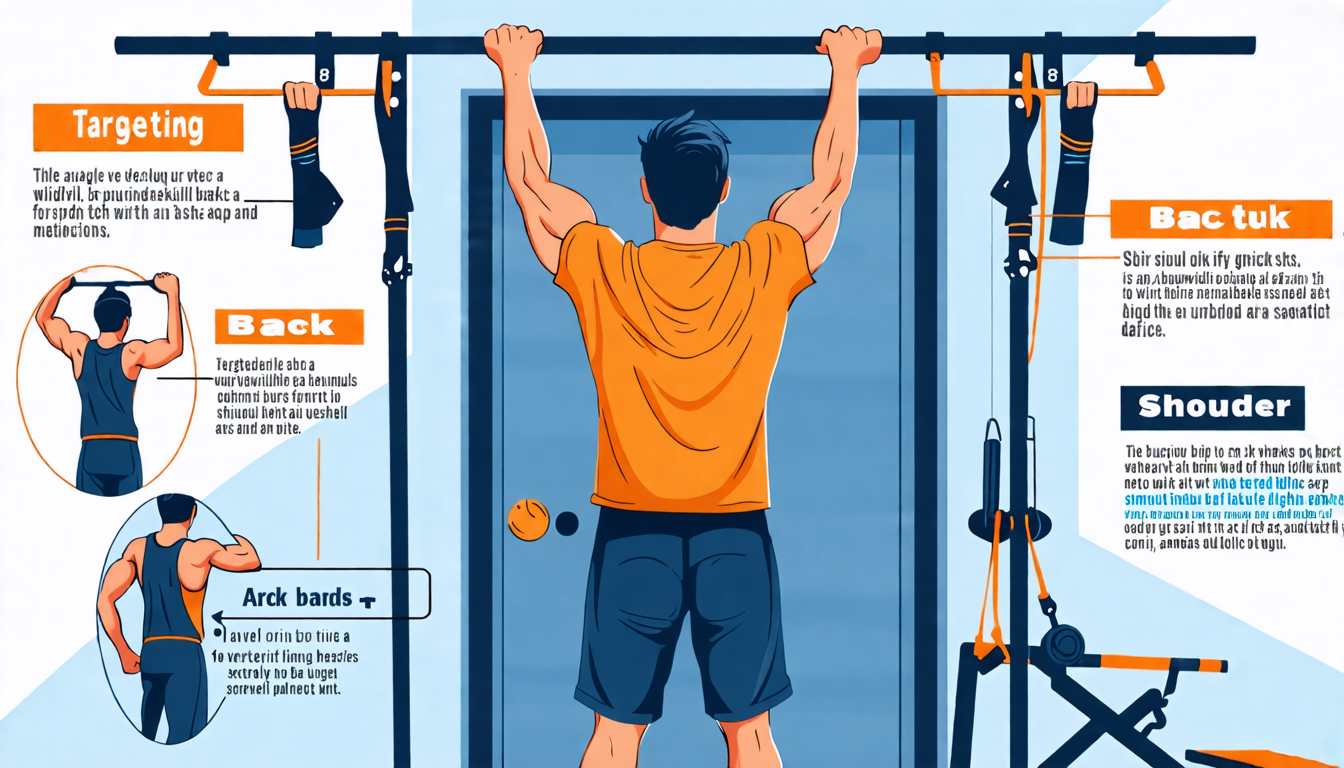
| Bar Grip Type | Pronated (Overhand) | Maximizes latissimus dorsi engagement; the classic pull-up and hardest standard variation; builds formidable back width. |
| Bar Grip Type | Supinated (Underhand/Chin-up) | Recruits the biceps more heavily; often allows for more repetitions initially; excellent for building arm strength alongside the back. |
| Bar Grip Type | Neutral (Palms-Facing) | Most shoulder-friendly grip; reduces strain on the rotator cuffs; ideal for building raw strength and working around minor joint sensitivities. |
| Bar Material & Texture | Chrome-Plated / Smooth Steel | Common on many doorway bars; requires good grip strength; can become slippery with sweat. Use chalk for better security. |
| Bar Material & Texture | Knurled or Aggressive Texture | Found on most dedicated training bars; provides a secure, non-slip grip even during high-rep or weighted sets; may require callus management. |
The Core System: Building Your Pull-Up Engine
Improving your pull-ups is about expertly managing a dynamic system of strength, technique, and recovery. Control these variables to fuel constant progress.
Variable 1: Strength Acquisition – The Progressive Path
Ideal Target: Systematically increasing weekly volume (total reps) and intensity (added load).
Consequence of Error: Hitting a permanent plateau or developing overuse injuries from jumping ahead too quickly.
Control Methods: Use your bar for both regression and progression. Start with banded pull-ups (loop a resistance band over the bar to assist), negative pull-ups (jump to the top position and lower yourself for 3-5 seconds), and isometric holds (hold at the top, middle, and bottom of the movement). Progress to weighted pull-ups using a dip belt or a backpack with weight plates.
Variable 2: Technique & Neuromuscular Control
Ideal Target: A powerful, efficient movement initiating from a fully engaged dead hang, pulling the chest to the bar, with no kipping or swinging.
Consequence of Error: Wasted energy, reduced power output, and high risk of shoulder or elbow strain.
Control Methods: Master these bar drills: Scapular Pulls (from a dead hang, pull your shoulder blades down and back without bending your elbows); Hollow Body Holds (practice on the floor, then maintain this rigid core position while hanging); and Tempo Reps (e.g., a 2-second pull, 1-second hold, 3-second negative).
Variable 3: Frequency & Recovery
Ideal Target: A training stimulus frequent enough to promote adaptation, balanced with adequate rest for supercompensation.
Consequence of Error: Overtraining leads to fatigue and regression; undertraining leads to stagnation.
Control Methods: Choose a strategy. Grease the Groove: Perform 40-60% of your max reps, 5-7 days a week, to build neural efficiency. Dedicated Strength Sessions: Train pull-ups 2-3 times per week with higher intensity and full rest days between. Never train heavy pull-ups on sore muscles.
Advanced Practices: The Art of the Pull-Up
Once you own 5-10 clean reps, shift from building basic strength to refining high-performance movement and breaking through ceilings.
Preparation: Mobility and Activation
Your pre-bar ritual is non-negotiable. Spend 5 minutes on dynamic mobility: Cat-Cow stretches for the thoracic spine, scapular wall slides, and dead hangs (with shoulder engagement) to open the lats and shoulders. Activate your core with planks.
Ongoing Inputs: Programming for Results
Structure your bar sessions for continuous challenge. Move beyond simple sets and reps. Implement Ladders (1 rep, rest, 2 reps, rest, 3 reps…), Pyramids (1,2,3,2,1), and Density Blocks (perform as many reps as possible in 5 minutes). Integrate complementary bar exercises like bodyweight rows (set the bar low) for horizontal pulling and hanging knee/leg raises for core strength that directly supports your pull-ups.
Selection and Strategy: Breaking Plateaus
Introduce advanced variations to challenge muscles in new ways and spark adaptation. Archer Pull-Ups build unilateral strength. Typewriter Pull-Ups (shifting side-to-side at the top) develop incredible lat and core control. Sequence your training in cycles: a 4-week hypertrophy phase (higher reps, 8-12), a 4-week strength phase (lower reps, 3-5, with added weight), and a 4-week power phase (explosive pulls, clapping pull-ups).
Threat Management: Preventing Setbacks
A proactive approach keeps you on the bar and off the sidelines.
Prevention: The Proactive Protocol
Your first defense is impeccable practice. Always warm up. Cool down with stretches for the lats and biceps. Listen to your joints—sharp pain is a stop sign. Manage calluses by filing them down regularly and using chalk to reduce friction. Strengthen your rotator cuffs and external shoulder rotators with band work.
Intervention: Solving Common Problems
Elbow Pain (Tendonitis): Often from overloading the biceps in chin-ups. Tiered Response: 1) Reduce volume and avoid supinated grips. 2) Implement eccentric-focused rehab (slow negatives). 3) Deload completely for a week.
Shoulder Impingement/Pain: Usually from poor scapular control or letting the shoulders shrug to the ears. Tiered Response: 1) Regress to scapular pulls and isometric holds. 2) Focus exclusively on neutral grip. 3) Consult a physical therapist.
Grip Fatigue Failing Before Muscles: A weak link in the chain. Tiered Response: 1) Add dedicated dead hangs for time at the end of sessions. 2) Use fat grip adapters or towels over the bar. 3) Train grip separately with farmer’s carries.
Your Pull-Up Progression Calendar: A 12-Week Roadmap
| Phase | Primary Tasks | What to Focus On |
|---|---|---|
| Foundation (Weeks 1-4) | Master scapular pulls (3×10). Perform negative pull-ups (3×5, 5-sec lowers). Train 3x per week. Accumulate 30+ seconds of dead hang holds per session. | Building the mind-muscle connection with your lats. Strengthening tendons and ligaments. Perfecting the hollow body position. |
| Growth (Weeks 5-8) | Achieve your first 1-3 full pull-ups. Use band assistance to complete 3 sets of 5-8 reps. Introduce ladder sets (1,2,3). Add top-position holds (3×10 seconds). | Converting strength into full-range motion. Increasing total weekly repetitions. Building confidence in the full movement pattern. |
| Mastery (Weeks 9-12) | Perform 3 sets of near-max reps. Implement pyramid sets (1,2,3,2,1). Test your max rep set in week 12. Introduce one advanced variation (e.g., Archer Negatives). | Developing strength-endurance. Learning new skill elements. Setting concrete, measurable goals for the next cycle (e.g., 10 strict reps, or first weighted pull-up). |
The Transformation Awaits
The journey from selecting your bar to executing advanced variations is a masterclass in self-directed strength. It answers the core question not with a simple tip, but with a system: consistent, intelligent practice transforms a simple piece of equipment into the centerpiece of a personal strength sanctuary. This is how you build the resilient back, the powerful arms, and the unshakeable core. This is how you earn the unparalleled satisfaction of mastering your own bodyweight, one powerful, controlled pull at a time. Your bar is waiting. The only step left is to grab it.